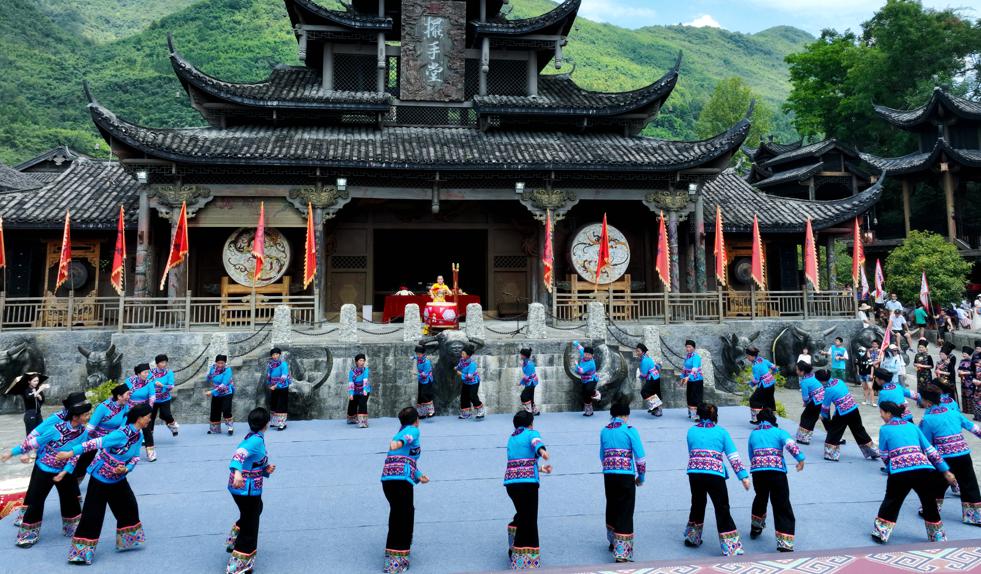
Baishou Dance
Introduction
The Baishou Dance is a traditional ceremonial folk dance performed during the Tujia people's traditional new year celebrations. Predominantly practiced in Yongshun, Longshan and Baojing counties in Hunan province, as well as Tujia communities in the border areas of Hubei, Sichuan and Chongqing, this dance embodies the rich cultural heritage of the Tujia ethnic group.
The Baishou Dance, meaning "Hand-Waving Dance", is renowned for its vibrant expressions of agricultural life, hunting and rituals, integrating music, singing and dance into a cohesive cultural performance.
History
The origins of the Baishou Dance can be traced back to ancient times, rooted in the Tujia people's animistic traditions and agricultural lifestyle. Historically, the dance served as a medium for ritualistic worship to honor ancestors and deities. Over centuries, it evolved into a structured performance art, featuring two distinct forms: Grand Baishou (大摆手) and Small Baishou (小摆手).
The Grand Baishou is held every three to five years, lasting up to seven or eight days and involving thousands of participants. It incorporates intricate formations and martial displays reminiscent of hunting and military drills. In contrast, the Small Baishou is an annual event celebrated within Tujia villages, emphasizing farming themes. Participants gather in multi-layered circles, with one leading dancer and others improvising in unison.
Features
The Baishou Dance is characterized by its unique combination of physical movements, storytelling, and communal engagement. Key features include:
Movement Technique: Dancers use same-side hand and foot motions, creating a flowing yet vigorous style. Movements are often accompanied by bowing, knee bending and twisting the torso, symbolizing agricultural or hunting activities.
Music and Song: Traditional Tujia instruments, such as drums and gongs, accompany the dance, interspersed with the rhythmic chanting of Baishou songs. This blending of music, singing and dance enhances the performance's immersive quality.
Themes: The dance reflects the Tujia people's daily lives, highlighting hunting, farming, military preparation and community interactions.
The version performed in Shemihutun village in Laifeng county in Enshi, Hubei, is particularly noted for its preservation of original features, showcasing a raw, primitive charm that connects modern audiences to its ancient roots.
Cultural Significance
The Baishou Dance holds profound cultural significance, serving various societal functions:
Ritual and Worship: Initially a dance to venerate deities and ancestors, it embodies the Tujia people's spiritual beliefs.
Community Bonding: It fosters social cohesion, bringing together men, women, and children in collective celebration.
Education: The dance transmits Tujia history, values and traditions to younger generations.
Artistic Expression: Its music, choreography and costumes reflect the Tujia people's aesthetic sensibilities.
As a dynamic cultural practice, the dance has significantly influenced the cultural identity of Tujia communities across Hunan, Hubei and Guizhou provinces as well as Chongqing municipality.
Preservation
Despite its historical and cultural importance, the Baishou Dance faces challenges in the modern era. The rapid pace of urbanization and social change has led to a decline in its practice, with fewer young people learning the art form. Efforts to preserve the dance include:
Cultural Documentation: Recording its music, movements, and songs for archival purposes.
Community Initiatives: Establishing workshops and festivals to engage local communities and revive interest.
Government Support: The dance has been recognized as an intangible cultural heritage in China, encouraging state-funded preservation programs.
Preserving the Baishou Dance ensures the survival of a vibrant expression of the Tujia people's heritage, safeguarding it for future generations.








